Navigation

Crochet Circle

Thursday, 7 July 2016

Third Kaleidoscope Cushion - design 14

The colours for the third design of my summer Kaleidoscope cushion collection was inspired by a visit to the seaside on a sunny warm day in June. The dog played on the beach we paddled in the sea and indulged in very big ice creams! The sea was very blue and the cliffs were two shades of rusty brown and in bright sunshine the sand was a pale beigy grey.

The colours didn’t seem like an obvious combination but if they work in nature.....When we came back from the seaside I had the inspiration for my 3rd cushion in my head and I couldn’t wait to start. For this 3rd cushion I wanted to show more detail of the crochet stitches so I needed to use a finer yarn.

Searching my stocks of yarn  I found some Shilasdair which is made using natural dyes  and is a lovely yarn  from independent spinners on the Isle of Skye. It has slubs of wool something that I love as it brings another dimension to the finished designs. In this cushion I used an oatmeal colour. For some reason finer yarns seem to have more subtle colours. I combined the Shilasdair with West Yorkshire Spinners 4 ply from the Spice range. The blue is Sirdar Country Style 4 ply. I used a 3.5 crochet hook.

The theme that runs through the Kaleidoscope collection is the colours and using colour combinations to define the designs. All of the Kaleidoscope collection were made by me when sitting in the garden when it was not always warm and I sometimes had to dodge the showers!
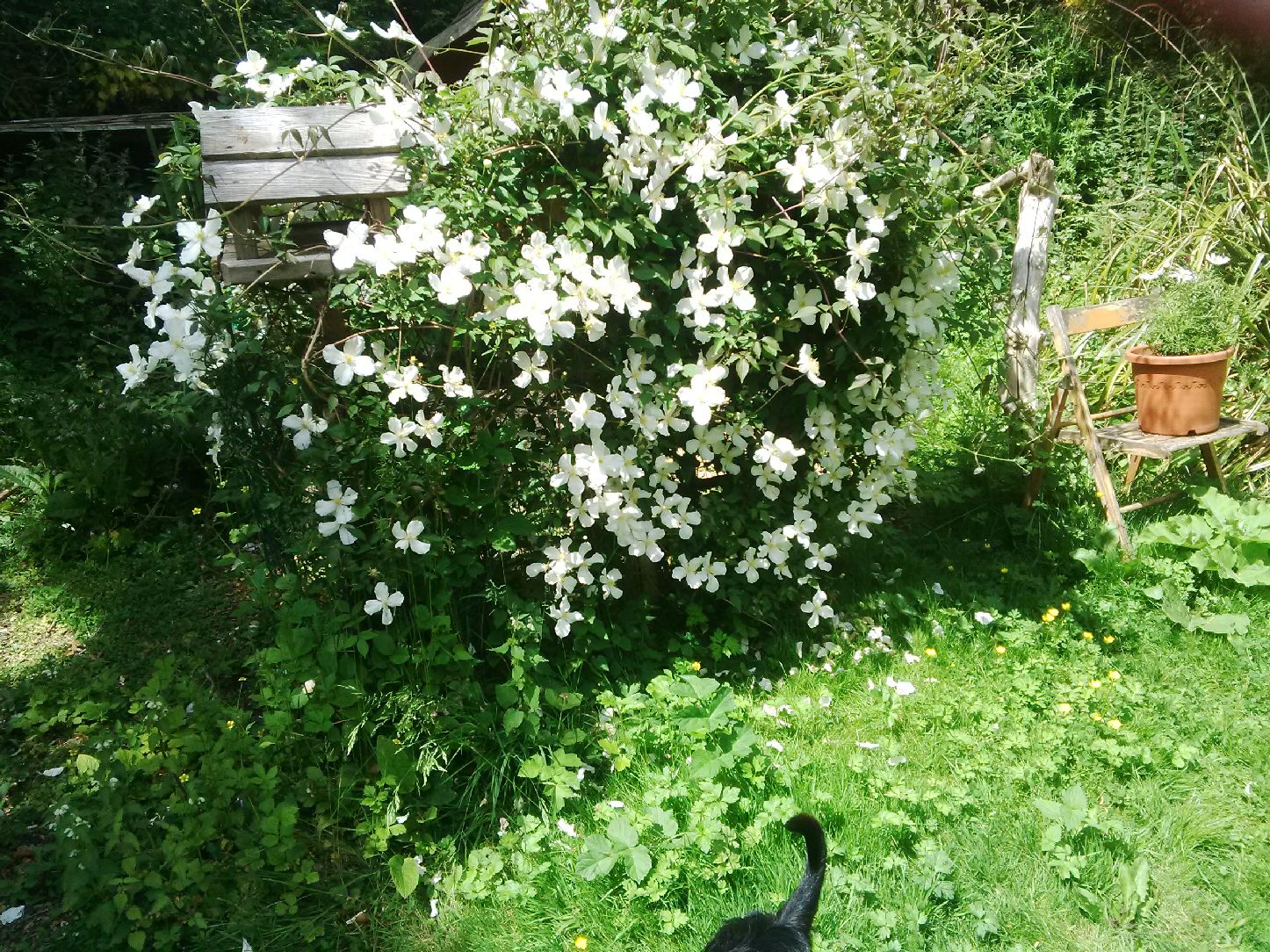
The garden in June


You can see the first Kaleidoscope cushion design 12 here and the second Kaleidoscope cushion design 13 here.

As you know I love embellishments and while I loved the finished design it looked a bit masculine with an all square design so I added the 3d roses. As you can see I loved making them and got a bit carried away. Find the pattern here

Third Kaleidoscope Cushion

The colours for the third design of my summer Kaleidoscope cushion collection was inspired by a visit to the seaside on a sunny warm day in June. The dog played on the beach we paddled in the sea and indulged in very big ice creams! The sea was very blue and the cliffs were two shades of rusty brown and in bright sunshine the sand was a pale beigy grey.

The colours didn’t seem like an obvious combination but if they work in nature.....When we came back from the seaside I had the inspiration for my 3rd cushion in my head and I couldn’t wait to start. For this 3rd cushion I wanted to show more detail of the crochet stitches so I needed to use a finer yarn.

Searching my stocks of yarn  I found some Shilasdair which is made using natural dyes  and is a lovely yarn  from independent spinners on the Isle of Skye. It has slubs of wool something that I love as it brings another dimension to the finished designs. In this cushion I used an oatmeal colour. For some reason finer yarns seem to have more subtle colours. I combined the Shilasdair with West Yorkshire Spinners 4 ply from the Spice range. The blue is Sirdar Country Style 4 ply. I used a 3.5 crochet hook.

The theme that runs through the Kaleidoscope collection is the colours and using colour combinations to define the designs. All of the Kaleidoscope collection were made by me when sitting in the garden when it was not always warm and I sometimes had to dodge the showers!
The garden in June


As you know I love embellishments and while I loved the finished design it looked a bit masculine with an all square design so I added the 3d roses. As you can see I loved making them and got a bit carried away. Find the pattern here

Monday, 4 July 2016

Sirdar Crofter Review


 Sirdar Crofter double knit (US equivalent) is a quality yarn at a good price. Very soft it is designed to create a Fair Isle effect in knitted jumpers and cardigans. 60% Acrylic and 25% Cotton a 50g ball gives a Yardage/metre of 170m/184y.

I’ve seen Crofter used in knitting to create that lovely Fair Isle look, but you can also use Crofter very effectively in crochet. Use Crofter to crochet tops and jackets. However when you use it for scarves, cushions or throws, Crofter will make a simple design look very effective and much more intricate than it really is.


Simple strips or motifs of double crochet Crofter looks very effective combined with other Sirdar yarns, including Baby Bamboo. Crofter would be lovely used  in a ripple pattern using contrasting or blended colours with the colours of the Crofter Fair Isle.


Popcorn stitches in Sirdar Baby Bamboo

I used Crofter for my summer bag/work bag. I added strips of Sirdar Crofter in a blue/rust/brown blend in double crochet in between rows of Sirdar double knit Snuggly. To add interest and to tone in with it Sirdar Snuggly double knit in a rusty brown colour.

Sirdar Crofter comes in a range of colours with dyes that tone in with other Sirdar yarns. Choose from 21 colours including pinks, purples, heathers, oranges, grey, greens and a lovely pale sea grass.


for a big selection of Sirdar and great customer service buy it from Little Lamb or The Wool Warehouse.


Wednesday, 15 June 2016

Designing an Edging

Adding an edging makes a massive difference to any finished item, giving it that little extra va va voom, whether it is a crochet cushion, throw or clothing. Go that extra mile with an edging and lift your crochet work making it something special to be proud. If you are making a gift with a beautiful edging the person receiving it will know you have gone that extra mile for them.

An edging can be as simple or complicated as you like and will frame your finished design. Or you can make the edging the main part of your design and this works particularly well if you are making a simple design.

What type of edgings?

Ruffle – can look very pretty and these are deceptively simple to make. Make a row of double crochet (SC). On the next row work 4 dc into each dc of the previous row, then continue making rows of dc’s on dc. Add some colourful stripes and your cushion throw or waistcoat will lookamazing.

Stitch lengthwise – make your edging by joining on to the last row of your work and create an edging row on row around your work.

Stitch horizontal - You can also make an edging separately by making a number of chains for the width of edging you want and by working horizontally. Carry on until your edging is the length you need, then attach by sewing on to your work or slip stitch together. This creates a completely different look to your work.

Plain stripes – use the colors of your project to create stripes. Make this edging special by working into the back loops only on all or rows or alternative rows to create a very pretty ribbed effect. Make uneven rows of colours or switch between trebles and double crochet (SC’s) rows.

Small or large edging – to create a frame for your main work, with a few simple stripes and a final row of shells stitches. This looks lovely on baby blankets. Depending on the size of your project make shells by working into every 3rd or 4th stitch (1dc 1htr 3tr 1htr 1dc).

Tassel it – add a few simple rows of a stripe edging, then add a final row of tassels, using the yarn of your work. You can add tassels to the corners only or all around. Be warned tassels use up a lot of yarn! To see how I used these edgings visit.....

Wednesday, 1 June 2016

Kaleidoscope cushion - design 13

Crochet Kaleidoscope cushion
My first Kaleidoscope cushion launched in April this year, featured multiple square motifs. The Kaleidoscope collection of three cushions are all inspired by my garden which is a bit wild and rambling! For the second of my Kaleidoscope cushions  You can see the first one here...I had the idea of one big square motif for the middle of the cushion. I had been experimenting with free form crochet and making ruffles which in free form add a 3D element to flowers and shells. I could see how using a ruffle would make a lovely edging for the cushion, so the two ideas came together!

When I designed this cushion late spring was here and wild campion was growing alongside ‘Lady's Mantle’ (alchamelia mollis) in the garden. It’s amazing how nature creates lovely combinations all by itself. The pretty pink of the taller campion was surrounded by the lime coloured leaves of Lady’s mantle and late spring showers made sparkly rain drops on the leaves lady’s mantle. This gave me the idea for the colours and the yarn for the second of the Kaleidoscope cushion.


My first Kaleidoscope cushion has a homely style. I wanted the second one to have a summery look and feel, something that would look good in a conservatory or on a garden chair. What yarn to use? I love Baby Bamboo! It’s a soft yarn with a lovely sheen and comes in a gorgeous choice of colours so it seemed the perfect choice. I use Baby Bamboo a lot, you can see it here in my summer holdall. When I designed this bag I used baby bamboo for the popcorn flowers and it really stands out.

For my second Kaleidoscope cushion, which is design number 13 I used 3 colours of baby bamboo, I used a lovely bright green and turquoise blue for the centre motif and added a pale pink for the ruffle edging. Read my Baby Bamboo review here.

Whatever I am designing I love combining yarns and the effects this produces. It makes a big difference to crochet projects. Baby Bamboo is reasonably priced but does not go as far as other 50gm yarns so it makes sense to combine it with something else. 


I decided on Sirdar baby cotton it is a rather dull looking yarn but is very soft and lovely to crochet with. Better still it goes a long way. The idea I had was to create a basic background effect with a heavier weight yarn to the finished cushion which would show case the lovely shiny baby bamboo and I think this has come off.

For the second Kaleidoscope cushion, Auriol Crochet design 13, I used 3 colours of Baby Bamboo a lovely bright green and turquoise blue for the centre motif with a pale pink for the ruffle edging.

I love fastening and I feel very strongly they should be a fundamental part of the design not just an add on. Kaleidoscope cushion 1 has big buttons on an envelope style fastening. Kaleidoscope is a bit more sophisticated with a different style of button. I added 2 buttons, but a row of buttons would look really good. You could pick any colour you sued in the cushion for the buttons or ix and match!

 I used hook size 3.50 (E4)


Tuesday, 26 April 2016

Kaleidoscope Cushion

Earlier this year I was practising some bullion stitches as part of a freeform design I am planning. Bullion stitches however you make them are a bit fiddly and take time to make. At the same time I was looking at my collection of textured stitches and I came across this variation on a treble which gives a similar look to a bullion stitch and is a lot easier to make.
Depending on how big you want your bullion stitch lookalike you make the clusters bigger by using more trebles.
You can find more of my hints and tips on how to improve your crochet here.....

I find inspiration for new designs from various places. Sometimes it’s something as simple as seeing flower combinations in the garden.

My summer bolster cushion with popcorn flowers were inspired by some pale lime Christmas Rose flowers that looked so lovely alongside the pale sage green/grey of the Brunnera that grows next to it.


I’ve been planning the design of my Kaleidoscope cushions collection since last autumn but a busy winter with crochet workshops and commission designs took up my time. You can follow the story of my Kaleidoscope Collection here......

Finally getting around to thinking about the new cushions I spotted a woven tapestry cushion in a shop window. It had squares of different bright colours with stripes of a main colour between them. As often happens this set me off on a myriad of ideas so I decided to design the first kaleidoscope using the tapestry idea and incorporate the treble cluster around stitch which is very nice to make. I offset the multi coloured squares which looks really nice, but it would equally as good if the squares were all in the same position.


I thought the style of the first kaleidoscope cushion would be better suited to an envelope style cushion. I made these decorative buttons which match the cushion and include the cluster around stitch. The first kaleidoscope cushion is easy to make and grows quickly, changing colour always stops me getting bored!

The pattern is ready to go click here 


Sunday, 10 April 2016

Ten Ways to Improve your Crochet Techniques

1. Hold your yarn as in the diagram it takes a bit of getting use to but is definitely worth it, it really helps keep your tension right and feeds the yarn more easily
2. Make a small piece of work if you are making garments, cushions and throws. Doing this will show you if you are crocheting too tight or too slack. It will save you time later on and prevent you having to pull out large pieces of work! Change to larger hook if your work too tight and a smaller hook if your work is too loose.
3. Use a larger hook for your foundation row if working a straight piece of work. This will make the loops of your foundation row larger and make it easier to crochet into the loops on the next row.
4. If you are making cushions, blankets or throws try using a different sized hook or thicker yarn for an open work finish.
5. If you can’t manage a magic circle you can create a similar effect by crocheting into the last chain. For example stitches for the first part of your magic circle are ‘1dc 5 tr 1dc’ (1sc, 5dc, 1sc US) make 3 or 4 chain and crochet the same stitches into the last chain, then join to the first stitch with a slip stitch.
6. If you are using motifs you don’t have to stick to the numbers of rows given make less or more rows as you like.
7. Having difficulty understanding which yarn to use for your pattern?

8. If you are crocheting in the round, count your stitches and use stitch markers or a piece bit of different coloured yarn to mark the beginning of rows.
9. Use a soft grip crochet hook rather than a metal one, they are more comfortable. Metal and plastic hooks make your hands sweat!
10. Try using different yarns of the same weight for your crochet cushions and throws, to create a different effect. For example add a tweedy yarn, one with silk in it or add a linen yarn. Using one ball of a more expensive yarn will make your finished project look more expensive.


How to improve the look of your crochet..... click here to read